The Last Mile: Turning a 360 TH/s Credit Into Spending Money
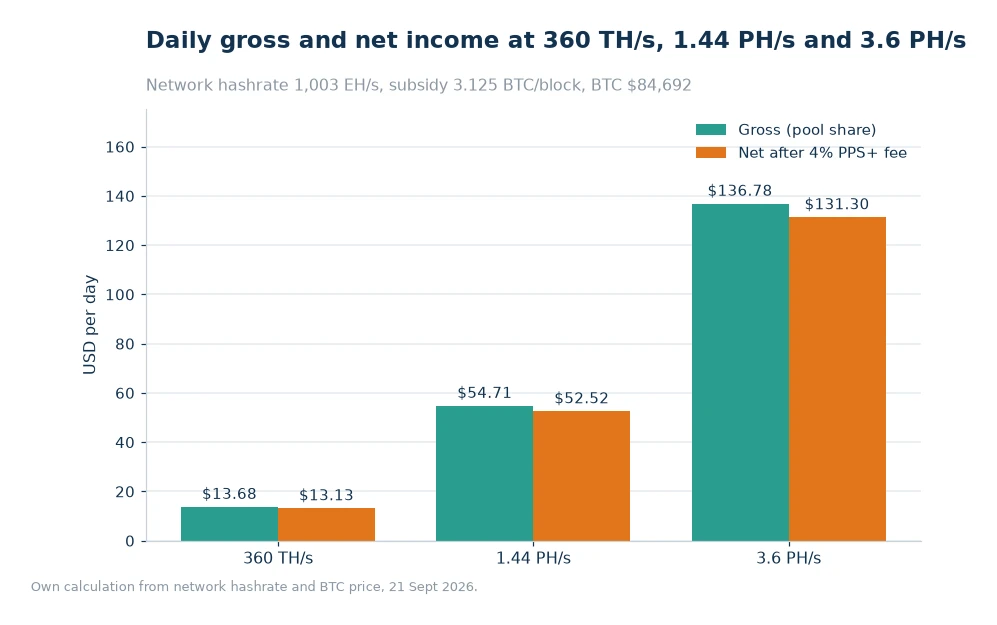
Mining produces a balance before it produces money. At 360 TH/s the pool credits 0.00016150 BTC a day, $13.68 at $84,692 per BTC and $13.13 after the listed 4% on the block-reward component, and that balance then has to be withdrawn, converted or held. The last mile is short, but it is where most of the avoidable friction in a small operation lives.

Key takeaways
- 360 TH/s credits 0.00016150 BTC a day, $13.68 gross and $13.13 after the listed 4% on the block-reward component.
- A month of continuous operation accrues 0.00465120 BTC, or $393.87 at $84,692.
- Mining payouts are zero-fee, so the withdrawal step does not reduce the balance the way an exchange fee would.
- 1.44 PH/s and 3.6 PH/s multiply the same balance by four and ten, to $52.52 and $131.30 a day.
A balance is not a bank deposit
The pool credits an amount to an account. It does not deposit dollars into a current account, and it does not send coins to a hardware wallet unless a withdrawal is requested or an address is configured. That distinction matters for planning, because the credit can be viewed as either a growing stock of coins or a series of payments waiting to be moved, and the two views lead to different habits.
The withdrawal side is unusually simple here: mining payouts carry no fee, so moving the balance does not silently shave a percentage off the arithmetic. What remains is the question of destination and timing, and those are decisions about the rest of the business rather than about mining. A miner who pays power from a bank account and holds coins has one set of habits; a miner who pays the power bill from mined coins has another.
Deciding how much to convert
Conversion is a separate decision from mining, and it deserves to be written down as one. At $84,692 per BTC, a month at 360 TH/s is worth $393.87 before power and before any conversion. If the power bill for the same month is $280, then roughly 71% of the credit has to become fiat to cover it, and the remainder is either held or spent on the next piece of hardware. That ratio is a plan, and it changes when the tariff changes.
Auto Conversion turns a chosen portion of each payout into another currency without a manual step, which is useful for exactly this kind of ratio. Set the part that covers the recurring bill, leave the rest in BTC, and the operation stops depending on somebody remembering to convert on the right day. The setting is a convenience, not a strategy; the strategy is the percentage, and that comes from the bill rather than from a price chart.
One balance, several currencies
The ViaBTC Crypto Mining account includes a multi-currency wallet, so the mined coins and the converted balance sit in the same place as the mining dashboard. That reduces the number of statements to reconcile and removes a transfer to an exchange from the routine, which is where most small operations lose both time and a fee they did not plan for.
Holding the balance in the account also makes the monthly review straightforward. The credit history, the conversion history and the withdrawal history are all there, and the three should agree: the credits sum to the balance plus withdrawals and conversions. When they do not, the gap is usually a conversion done at a different moment than expected, or a payout that arrived after the review was written.
Four horizons, one balance
The table follows the same daily credit across four horizons at a constant price and difficulty. It is not a forecast; it is what the balance looks like if nothing changes, which is a useful reference against which a real month can be compared.
| Horizon | BTC accrued | USD at $84,692 | Share of a $280 bill |
|---|---|---|---|
| 1 day | 0.00015504 | $13.13 | 4.7% |
| 7 days | 0.00108528 | $91.91 | 32.8% |
| 30 days | 0.00465120 | $393.87 | 140.7% |
| 90 days | 0.01395360 | $1,181.61 | 422.0% |
The fourth column is the one that turns a mining figure into a household or business figure. A month clears the bill with room to spare; a week covers about a third of it. That is the shape of the cash flow, and knowing it in advance is what makes a weekly conversion schedule possible instead of a monthly scramble.
Worked example
Follow the 360 TH/s credit from the network arithmetic to a converted balance.
- Per terahash: 450 BTC a day divided by 1,003,107,267,295 GH/s is 0.00000044861 BTC.
- 360 TH/s: 360 multiplied by 0.00000044861 is 0.00016150 BTC, or $13.68 at $84,692.
- Listed 4%: 0.00016150 multiplied by 0.96 is 0.00015504 BTC, or $13.13.
- One month: 30 multiplied by 0.00015504 is 0.00465120 BTC, and 30 multiplied by $13.13 is $393.87.
- A $280 power bill: 280 divided by 393.87 is 71.1%, so $113.87 of the month can stay in coins.
- Ninety days: 90 multiplied by $13.13 is $1,181.61, or about four months of the same bill.
- Four machines at 1.44 PH/s: 4 multiplied by $13.13 is $52.52 a day, and ten at 3.6 PH/s is $131.30.
The alternative to selling
Some operators would rather keep the coins and borrow against them for a short period, and that is a product decision rather than a mining one. Collateral-Pledged Loans follow a fixed sequence: Add Collateral, then Apply for Loan, then Receive Loan, then Repay Loan, then Redeem Collateral. The coins stay pledged while the loan is outstanding, which means they are not available to sell in the meantime.
Whether that trade is worth making depends on the loan terms and on how long the coins would otherwise sit idle, and it should be compared with simply converting the amount needed for the bill. The mechanical comparison is the same as any other: the cost of the loan against the cost of selling at the current price, with the added constraint that pledged collateral is locked until it is redeemed.
There is a planning value in the lock as well as a cost. Coins pledged against a loan cannot be sold on a bad afternoon, which removes one common way a short-term price move turns into a permanent decision. The cost is that they also cannot be sold on a good one, and the loan has to be repaid from somewhere. An operator who borrows should know which of the two effects is the reason, because only one of them is a plan.
Frequently asked questions
How quickly can mined coins be spent?
The pool credits 0.00015504 BTC a day at 360 TH/s after the listed 4%, and with zero-fee mining payouts the balance can be withdrawn or converted without a payout fee reducing it.
Should I convert every payout to cash?
Only the part needed for recurring costs, such as the power bill, which at $280 a month against a $393.87 credit is about 71%, while the remainder can stay in coins or fund the next machine.
Can I borrow against mined coins instead of selling?
Yes, through Collateral-Pledged Loans, which follow Add Collateral, Apply for Loan, Receive Loan, Repay Loan and Redeem Collateral, with the pledged coins locked until the loan is repaid.
Map the last mile before it matters
Write the monthly credit, the recurring bill and the percentage that has to be converted, then set the conversion once and check it monthly. The multi-currency wallet holds the result in one place, and if borrowing is on the table, the Collateral-Pledged Loans page sets out the steps and terms before any coins are pledged. A last mile that is planned is short; one that is improvised is where small operations quietly lose their margin.
Sources: the ViaBTC homepage for payout and wallet terms and the loan page for the collateral sequence[1]. Chain inputs read 21 Sept 2026: network hashrate 1,003 EH/s, difficulty 132.76 T, subsidy 3.125 BTC per block, 144 blocks a day, BTC $84,692. Published 22 Oct 2026. Balances assume continuous operation, current difficulty and no withdrawals.