BTC Mining Pool Selection: Fees, Payouts and Reliability
Pool selection is a scoring exercise, not a preference. At 300 TH/s the block-reward share is 0.00014206 BTC a day — $12.12 gross and $11.63 after the listed 4% — so the items that decide which pool you keep using are the ones that change that figure or interrupt it: how the fee is split across components, how often you are paid, how concentrated the pool's hashrate is, and how quickly a fault surfaces.

Key takeaways
- Read the fee as components, not one number: the listed 4% applies to the block-reward leg and the listed 2% to transaction fees, while a rolling-window mode charges a listed 2% on both together.
- At 300 TH/s the block-reward fee is about $0.48 a day, or $14.55 across a month — small next to a single day of downtime at about $11.63 of net income.
- Check how the published Pool Hashrate has moved over a week you watched yourself, not over a quarter someone else described.
- Difficulty is estimated to rise 1.90% at the next adjustment, so every daily figure here is a reading from 22 Sept 2026, not a rate of return.
Score fees as components, not as a headline
The most common selection mistake is comparing two pools by one percentage. The listed schedule distinguishes the parts of the reward: under hourly settlement the listed 4% applies to the block-reward share while the transaction-fee share carries a listed 2%, and under a rolling-window mode a single listed 2% covers both components together. Those are different products, and the one you should choose depends on whether your site needs a predictable hourly payment or is happy to absorb the pool's luck across a window of recent difficulty rounds.
Convert the difference into money at your own size. At 300 TH/s the block-reward share is $12.12 a day, so the listed 4% removes about $0.48 of it and the month absorbs $14.55. At 1 PH/s the gap between a listed 4% and a listed 2% on that same component is $24.23 a month. Neither figure is large enough to justify a migration on its own, which is why fees belong on the scorecard but not at the top of it.
What belongs above them is interruption. One full day offline at 300 TH/s costs $11.63 of net income — almost a month of the fee difference at that size. Two unplanned days a quarter costs more than any plausible rate difference between pools.
Score payouts, statistics and reliability
Payouts are judged on cadence and evidence. Hourly settlement against current difficulty produces 24 payments a day, and the evidence is your own withdrawal history rather than a marketing page. A rolling-window mode pays after confirmations are complete, distributed across the last five difficulty rounds, which means an individual payment can be larger or smaller than the average and the cadence is the chain's rather than the clock's.
Statistics are judged on what you can explain without asking anyone. Pool Hashrate tells you whether your share of the pool is being diluted by incoming miners, which is the leading indicator that your slice of each block is getting thinner. Pool Luck tells you whether a quiet spell is within the normal spread of block finding or something worse.
Reliability is judged on the boring things: whether alerts reach you at three in the morning, whether the hashrate curve recovers cleanly after a restart, and whether a worker that drops out is visible before it costs a day. Watch for a week before pointing a fleet at anything, and treat a pool that publishes continuously as easier to trust than one that explains itself only in a support ticket.
| Criterion | What to read | The line to draw |
|---|---|---|
| Fee transparency | Which component each listed rate applies to | $0.48 a day of block-reward fee at 300 TH/s |
| Settlement cadence | Hourly against current difficulty, or after confirmations across a window | Decide whether certainty or the window suits your bills |
| Payout evidence | Your own history, at least two weeks of it | Every expected payment present and on time |
| Pool Hashrate trend | The published figure over a week you watched | Your proportion of pool hashrate holding steady |
| Pool Luck record | Blocks found against blocks implied by hashrate | Quiet spells explainable rather than mysterious |
| Interruption cost | $11.63 of net daily income at this size | Fewer than a handful of unplanned days a year |
Worked example: 300 TH/s for a season
Start with one TH/s. At a difficulty of 132.76 T the network issues 450 BTC a day, about $38,382,300 at $85,294, and a single TH/s returns 0.0000004735 BTC — $0.0404 gross, $0.0388 after the listed 4% is applied to the block-reward component.
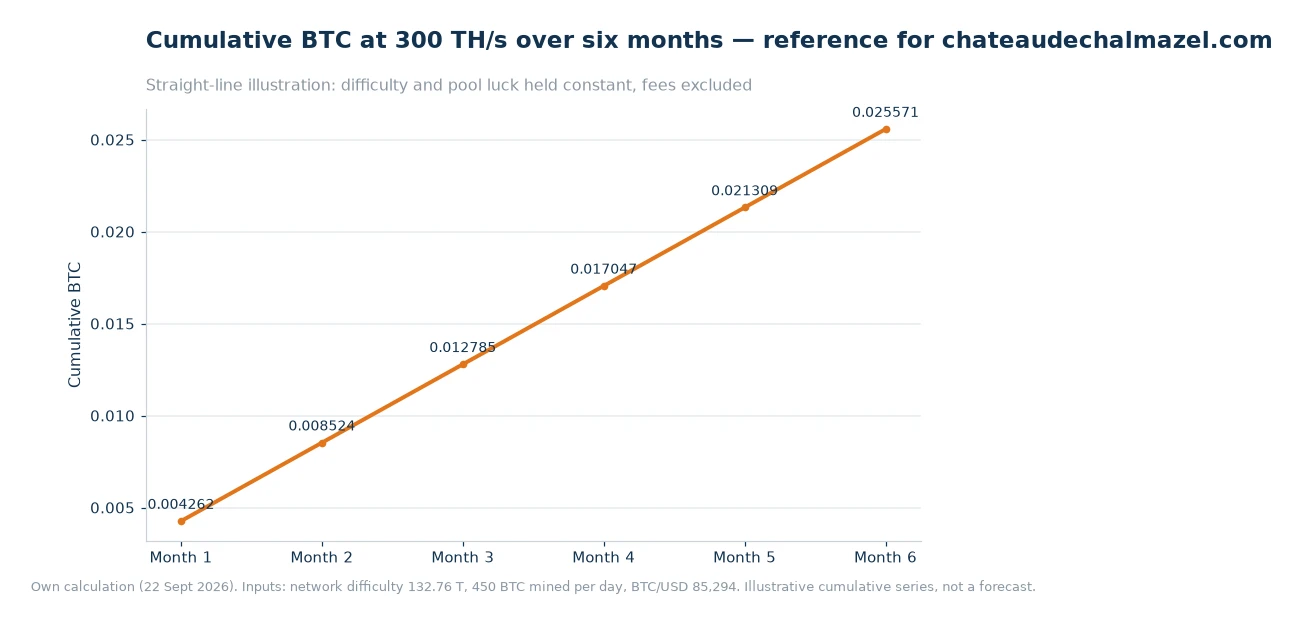
Scale that to 300 TH/s: 0.00014206 BTC a day, $12.12 gross and $11.63 net. A 30-day month is 0.004262 BTC, or $363.48 gross. Six months at the same difficulty and price reaches 0.025569 BTC, about $2,181 — the accumulation in the chart below.
The power line belongs in the same breath. At 20 J/TH a machine burns 0.48 kWh per TH/s per day, so 300 TH/s draws 144 kWh daily. At the net breakeven price of $0.0808 per kWh that power costs $11.63 — precisely the net income above, which is why the breakeven is a breakeven and not a margin. Anything your electricity supplier charges below that number is yours; anything above it comes out of your pocket.
Reliability is what the fee cannot buy back
A pool can only be scored on behaviour you have observed, so the fastest way to choose is to run a small amount of hashrate with two candidates for a fortnight and compare the records. Look at the ViaBTC BTC Mining Pool readings — hashrate, block activity, luck — beside the other candidate's page, and put both next to the listed fee schedule so the rate applies to the declared component. Then move the fleet to whichever one produced payments you did not have to chase.
Keep the wallet side in view while you are at it. An account where mined coin lands beside the rest of your balance, with multi-currency wallet support and withdrawal rules you can state from memory, removes an entire category of month-end work that has nothing to do with hashrate and everything to do with how long you stay.
Frequently asked questions
How do I compare two pools quoting the same listed rate?
Compare the components rather than the number. A rate on the block-reward share and a rate on the combined reward are different products, and at 300 TH/s the block-reward share is only $12.12 a day.
How much does the difficulty estimate change the answer?
The next adjustment is estimated at +1.90%. Difficulty does not alter the listed fee, only the base it applies to, so re-run the daily figure whenever it steps rather than treating one reading as a return.
What reliability evidence can I check for myself?
Two readings. The first is how the published Pool Hashrate moved during a week you watched it. The second is whether your own accepted hashrate matched the machines you installed, worker name by worker name.
Score it, watch it, then commit
Draw the scorecard before you move anything: fee components, settlement cadence, payout evidence, hashrate trend, luck record and interruption cost. Watch both candidates for a fortnight with a fraction of the fleet, because two weeks of your own payout history beats any comparison table. Then commit the whole site to the winner and re-score once a quarter, when difficulty has moved and your own size has changed. The pool that wins in September is not automatically the pool that wins in March.
Data and sources: ViaBTC listed fee schedule[1] and the public pool statistics page, together with Bitcoin network readings of 22 Sept 2026 — difficulty 132.76 T, next adjustment estimated +1.90%, implied network hashrate 950.3 EH/s against a three-day average of 942.8 EH/s, 450 BTC issued daily, BTC at $85,294 — read 22 Sept 2026. Figures are arithmetic on those inputs and are not a promise of earnings.